1. Introduction
This study examines the role divination plays in resolving ailments and disorders among the Dagomba in the Northern Region. The purpose of this study is to describe how demographic characteristics are used to influence the practice of divination. The aim of the study is to describe the function of divination in the treatment of ailments among the Dagomba.
In most countries, the supernatural plays an important part in determining the etiology of numerous ailments. According to
| [8] | Azongo, T. B., & Wombeogo, M. (2015). Consulting Diviners for Health: The Influence of Socio-Demographic Factors On the Use Of Divination In Health-Seeking In Northern Ghana. International Journal of Innovative Research and Studies, 4(1), 176-193. |
[8]
the supernatural has a significant role in the causation of many diseases among the Dagomba. He also stated that the supernatural has numerous agents that induce a variety of ailments. This supernatural phenomenon can only be explained in metaphysical terms
| [1] | Abotchie, C. (1997). Social Control in Traditional Suouthern Eweland. Relevance for modern crime prevention in Ghana. (1st ed.). Accra: Ghana Universities Press. |
| [2] | Adongo, B. P., Philips, F. J., & Binka, N. F. (1998). The Influence of Traditional Religion on Fertility Regulation Among the Kasena Nankana of Northern Region. Studies in Family Planning, 29(1), 23-40. |
| [26] | Mendonsa, E, L. (1982). The Politics of Divination. A Processual View of Reaction to Illness and deviance among the Sisala of Northern Ghana (First). California: University of California Press. |
| [30] | Nukunya, G. K. (2004). Tradition and Change in Ghana (6th ed.). Accra: Ghana Universities Press. |
[1, 2, 26, 30]
. Everyone accepts the concept of well-being. As a result, humans look for it. These efforts vary between societies. As a result, in circumstances where scientific science is unable to treat specific illnesses or events, people may seek divine intervention to address their health concerns. According to Giddens
| [3] | Anthony, G. (1998). Sociology (second). Oxford: Polity Press. |
[3]
, organisms evolve in their natural surroundings. As a result, human well-being is a constantly shifting state of existence. In Dagomba civilization, diviners function as gatekeepers for ancestor worship
| [7] | Awalu, B. (2009). The Dagomba supernatural beliefs and care of the sick. In C. Oppong, P. Antwi and K. W. (ed.), Care of the Seriously Sick and Dying. Perspectives from Ghana. (pp. 211-227). Bergen, Norway: Allkopi. |
[7]
. According to Oppong
| [32] | Oppong, C. (1973). Growing up in Dagbon. (First, Ed.). Accra, Tema.: Ghana publishing Corporation. |
[32]
, the majority of indigenous Dagomba proprietors own shrines known as bugli. This is where propitiation's are done for the forebears. This establishes the connection between the living and the deceased. When the dead strikes certain abnormalities will be occurring in the family such as death, sickness, crop failure and animals dying.
Assimeng
| [5] | Assimeng, M. (2010). Religion and Social Change in West Africa (Second). Accra: Woeli Publishing Services. |
[5]
underlined the tight relationship between spirits and medicine in African communities. It is mentioned in African communities that nothing can be right among men if there are no proper relationships between humans in the cosmos.
According to Pritchard
| [35] | Pritchard, E. E. E. (1976). Witchcraft, Oracles and Magic among the Azandes (2nd ed.). Melbourne Auckland: Oxford University Press. |
[35]
, Azande people believe in witchcraft activity, and so witchcraft has the potential to bring harm due to its intrinsic nature. He went on to say that the same folks believed sorcery could cause illness. Because of this circumstance, the Azande use divination and medicine for direction. As a result, when an azande consults diviners or uses oracles, it is because of witches.
Opoku
| [33] | Opoku, K. A. (1978). West African Traditional Religion. Accra: International Private Limited. |
[33]
, who studied traditional religion in Africa, claimed that medical practice in Africa is inextricably linked to religious activity. He says that religion in Africa addresses all aspects of life and helps people cope with its ups and downs. As a result, health issues are more than merely healing from illness; they can also be about preservation in religious settings.
In addition to causing disease, death, and sterility, Field
| [19] | Field, M. J. (1960). Search for security: An ethno-Psychiatric study of rural Ghana. London: Faber and Faber Limited. |
[19]
asserted that witches are responsible for a wide range of social problems, including poor crop performance, financial losses, misfortune, and calamities. The book believes that witches induce relatives to become intoxicated and impotent. As a result, many people seek refuge in shrines and with diviners.
Mbiti
| [25] | Mbiti, J. S. (1990). African Religions & Philosophy. London: Heinemann. |
[25]
claims that religion is so deeply embedded in all aspects of life that it is not always easy or practicable to separate it. He claims that studying traditional African religions involves an exploration of the peoples themselves, taking into account all aspects of both traditional and contemporary life. As a result, Africans' habit of seeking health care is deeply interwoven in their religious beliefs, involving ceremonies, sacrifices, and the usage of herbs, roots and spiritualism.
"The strongest component of traditional background is religion, which also likely has the biggest impact on how people think and live" Mbiti
| [25] | Mbiti, J. S. (1990). African Religions & Philosophy. London: Heinemann. |
[25]
. According to Assimeng
| [6] | Assimeng, J. M. (2007). Social Structure of Modern Ghana (2nd ed.). Tema: Ghana Publishing Corporation Assembly Press. |
[6]
, Oboade (Akan), Nyonmo (Ga), Mawu (Ewe), Naawuni (Dagbani), and others regard the supreme being or creator as the basis of Ghana's ancient cosmology. It is thought that the ultimate entity is the source of all life and power. In addition to his many names, God the creator is also known as the Omnipotence, and the traditional people worship him as such, seeking peace, prosperity, and protection.
According to Bierlich,
| [11] | Bierlich, B. (2007). The problem of money African Agency and Western Medicine in Northern Ghana. |
[11]
, a Dagomba feels secure enough to call his maternal ancestors to ensure success and safety in a competitive economy where job searching, promotions, passing exams, and protecting oneself and money from enemies are all concerns. Typically, ancestral worship consists of offering sacrifices prayers and consulting diviners for health.
A Dagomba uses sacrifices and prayers to approach the ancestor spirits (Wuni) when things get worse. "Their own concept of ill-health, which includes unscientific knowledge systems that grow over generations within different societies before the arrival of western science," is what
| [10] | Bierlich, B. (2004). The problem of money (first). New York: Bernghahn Books. |
[10]
defined as traditional medicine. Shizha,
| [36] | Shizha, E., & Charema, J. (2011). Health and willingness in South Africa: Incorporating indigenous and Western healing practices. Institutional Journal Psychology and Counselling., 3(9), 167-175. |
[36]
examined the role of traditional medicine practitioners in Africa and and indicated that they are contributing to meeting the population's fundamental health requirements. For example, many people choose traditional treatment to orthodox care because of the high expense of western medicine. According to Gyekye,
| [21] | Gyekye, K. (1996). African Traditional Values. Accra: Sankofa Publishing Company. |
[21]
explanation of African traditional values, traditional medicine benefits roughly 75-85% of Ghana's rural population and 45-65% of its urban residents. According to Konadu,
| [23] | Konadu, K. (2008). Medicine and Anthropology in Twentieth Century Africa: Akan Medicine and Encounters with (Medical) Anthropology, 10(2007). |
[23]
article on traditional medicine, around 85% of individuals globally seek out traditional medicine before turning to western medicine. It is impossible to overstate the importance of traditional medicine. For example, according to a 2010 census conducted in Ghana, there are 400 persons for every practitioner of traditional medicine, whereas the orthodox medical ratio is 17,733. Traditional medicine's basic premise is that people are both physical as well as a supernatural being. As a result, both bacterial and supernatural inversions of the human body can induce sickness.
1.1. Concept of Divination
Divination defers a single definition most scholar difined it in different ways. Some people call diviners soothsayers depending upon the culture and belief of the society
| [31] | Nukunya, G. K. (2003). Tradition and Change in Ghana (2ed.). Accra: Ghana University Press. |
[31]
. Ngutor,
| [28] | Ngutor, S. Lumun, A. & Terwase, I. (2013). The Role of Divination in Treatment of Disease in Kwande Local Government Area of Benue State, Nigeria. International Journal of Humanities and Social Science Invention, 2(10), 21-29. |
[28]
ascertained that, “Divination is the art of gain vision into a situation by using occult methods, standardized process or a ritual”. Nukunya
| [30] | Nukunya, G. K. (2004). Tradition and Change in Ghana (6th ed.). Accra: Ghana Universities Press. |
[30]
opened that divination is a situation in which explore to gain access to possess wealth, the anxiety to ascertain causes of sickness, exploring for a missing property, and what ever one can do to attain success and whatever information may be required for the welfare of a customer. Annus
| [4] | Anus A. (2010). Divination and interpretation of signs in the Ancient World. Oriental Institute Seminar. |
[4]
explains that divination is a method of knowledge gaining to acquire the causes of unforeseen, whether now, yesterday or time to come and methods to remove such causes for one’s fortunes. Meyer
| [27] | Meyer (1999). Translating the devil: Religion and modernity among Ewes in Ghana (1st edit). London: Edinburgh University Press. |
[27]
ascertained that divination is a credence in the paranormal and subtle powers in which an individual could ascertain health, honor, wealth or other pleasures. Divination therefore is a structured process of arranging what appears to be disordered, in that the diviners gives clarification to issue on the table. Divination is socially design and provides a ceremonial attributes, usually in the form of religious manner. many societies employ divination as protective mechanism and is largely patronize by people with conditions such as bareness, warriors and people with the perception that their enemies are likely to strike on them with witchcraft powers, sorcery and spiritual possessions.
1.2. Conceptual Structure
The social constructivist theory serves as the foundation for this investigation. The idea that the world is created by everyone is based on the ideological foundation of social creation of reality. In the sociological dimension, Berger and Luckman
| [9] | Berger, P. L. & Luckmann T. (2010). The Social construction of reality. New York: Doubleday. |
[9]
held that daily activities are socially produced. People's thoughts and actions, for example, are likely to have a significant impact on their actions and in-actions. That is, people's thoughts become actual and have an impact on their daily circumstances. The process by which any body of "knowledge" becomes regarded by society as "reality" was the focus of Berger and Luckman's
| [9] | Berger, P. L. & Luckmann T. (2010). The Social construction of reality. New York: Doubleday. |
[9]
investigation. The process by which individuals consistently produce a shared reality that is seen as objectively factual through their interactions and behaviors is referred to as "reality construction."as well as subjectively significant. They made the assumption that everyday reality, which consists of both objective and subjective components, is a socially created system in which individuals assign a particular order to common place phenomena. Subjectivity is defined as the reality having personal significance for each individual. By objective, they mean the institutional world's social order, which they consider to be a human creation. According to Luckman and Berger, both the subjective and objective worlds exist and provide context for society at large.
The question of how every reality is socially created as "here and now" is at the heart of this theory. The past, present, and future are all impacted by this reality.
1.3. Methodology
The study's six-month data collection phase ran from March to August 2016. For this study, three districts, one municipality, and one metro area were used. I had a community gatekeeper at each study location who also served as a researcher assistant. The community gate guards identified and located the respondents. Before conducting the interviews, I made multiple field visits to each district with the research assistants to get to know the respondents. For the quantitative survey, we located every diviner, medical professional, and respondent. Every location where these interviews were conducted was mapped out. We visited eight diviners from the five MMDAs (Metropolitan, Municipal and District Assemblies) in order to gather data. Through the Assemblyman or the community gatekeeper, we alerted the diviner or the personality concern in advance of each visit. But as the Dagbon tradition requires. Every time we go to a village, we give the chief and the opinion leaders cola nuts and ask for their support before beginning the interview process. We conducted interviews at Yendi Kariga, Gushegu, Zabzugu and Tamale.
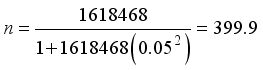
This study involved quantitative study with community based survey which employed the use of questionnaire for data collection. The questionnaires were pretested at Savelugu municipality to ascertain the validity and its reliability. The sample size was calculated using Yamane’s
| [37] | Yamane T. (1967) Statistics an Introduction Analysis. 2nd Edition, Harper and Row, New York. |
[37]
formula. A sample of 400 was arrived at. The administration of the questionnaires was done by the use of probability sampling approach. As such every member of the population was giving a chance to be selected or rejected in the sample to avoid biases. The WHO guide for immunization survey for training Mid-level Managers: EPI coverage survey (WHO/EPI/91: 10) was use to sample the respondents for the study. The process was a two stage sampling procedure where random sampling of households were done to select households and subsequently individual subjects. The initial stage was to identify the clusters of the study area which was divided in to five MMDAs. They are Tamale, Yendi, Gushegu, Karaga and Zabzugu. The population of the MMDCs were known but that of the communities were unknown. The next stage was sampling houses and individual subjects. After the individual respondents were selected, the interviews then began with 400 community elders, health professionals and diviners. After that the data was cleansed, coded and assigned to the Statistical Package for Social Sciences (SPSS) for data analysis. Quantitative research method is a methodological choice for many researchers from across a variety of disciplines. Creswell
| [17] | Creswell, J. W., Fetters, M. D., & Ivankova, N. V. (2004). Designing a mixed methods study in primary care. The Annals of Family Medicine, 2(1), 7-12. |
[17]
referred to quantitative method as a research approach with philosophical assumptions as well as research techniques. When using quantitative data in one study or numerous investigations, its philosophical presumptions drive the course of data gathering and analysis. The main idea using quantitative methods is that it improves comprehension of a phenomenon that could not be produced by qualitative method. Working with diverse data sets or employing quantitative approaches is what researchers appreciate. According to Bryman
| [12] | Bryman, A. (2008). Social Research Methods (3rd ed.). Oxford: Oxford University Press. |
[12]
, quantitative method research entails using and implementing single research approaches. That is quantitative approaches. The study was interested in exploring the opinion of the diviners and their clients about their views regrading diviner’s health care delivery, and how effective it is to supplement the modern health care practice. In each of the cases mentioned above, the community gate keepers of the various settlements personally introduced me to each of the diviners. Following the customary greetings and an explanation of our reason for visiting, we were given permission to speak with the diviners and other respondents.
Interview is a method of gathering data in which more time is spent answering fewer questions but more detailed information is gathered
| [24] | Kumekpor, T. (2003). Research methods and techniques of social research. Accra: SonLife Publshers. |
[24]
. It entails interviewing a person or group of people to find out what they think about a particular concept or circumstance is. Structured interviews are the possible formats. Accordingly, structured interview is a closed-ended guide that provides information regarding a phenomenon.
1.4. Study Setting
Selection of Respondents
The following respondents were selected for the interviews for this study. In the Tamale Metropolis, five Communities were sampled. They are, Lamashegu, Nyohini, Banvim, Kalpohine and Kukuo. Sampling was done according to the population proportion to sample size. At Lamashegu, 36 people were interviewed, 17 males and 19 females. Nyohini, 25 people were also interviewed, they were made up of 12 males and 13 females. Banvim, 37 people were interviewed at Kalponhene, they included 18 males and 19 females. A total of 177 people were interviewed in the Tamale Metropolis.
At the Gushegu District four Communitie were equally sampled through probability sampling procedure. They are Kpatinga, Gaa, Gariwe, and Nakunga. At Kpatinga, 20 people were selected and interviewed. They were 9 males and 11 females. In Gariwe Cmmunity, 12 people were interviewed, they also include 6 males and 6 females. In Gaa Community, 21 people were interviewed, they were made up of 10 males and 11 females. In Nakunga Community, 11 people were also interviewed, which includes 6 males and 5 females. A total of 64 people was interviewed in the Gushegu district.
In the Yendi Municipal, four Communities were selected and interviews were carried out. They are, Kuga, Adibo, Tusani and Gbungbalga communities. At Kuga Community, 44 people were selected and interviewd, they included 20 males and 24 females. In Adibo, 10 people interviewed, made upof 5 males 5 females. In Tusani community 8 people were interviewed, which includes 4 males and 4 females. At Gbungbalga community, 10 people were interviewed. They were 5 males and 5 females. A total of 74 people was interviewed in the Yendi Municipal.
In the Karaga District, four communities were selected. They are, Bagurugu, Karaga, Tamaligu and Kpatari Bogu. In Bagurugu community 14 people were interviewed, 7 males and 7 females. At Karaga community, 19 people were interviewed, 9 males and 10 females. In Tamaligu community, 11 people were interviewed made up of 5 males and 6 females. At Kpatari-Bogu Community, 13 people were interviewed this included 6 males and 7 females. A total of 58 people was interviewed in the Karaga district.
At the Zabzugu district, 3 communities were sampled They are Zabzugu, Woribogu and Kukpaligu Communities. A total of 29 people was interviewed in the Zabzugu district. At the Zabzugu Community 11 people were interviewed, they included 5 males and 6 females, whiles in the Woribogu community 10 people were interviewed, made of 5 males and 5 females. At the same time, 8 people were interviewed at the Kukpaliga Community made up of 3 males and 5 females.
1.5. Research Design
The study employed cross-sectional study design among Dagomba diviners and their clients within the northern region Ghana. Kesmodel
| [22] | Kesmodel, U. S. (2018). Cross‐sectional studies-what are they good for? Acta obstetricia et gynecologica Scandinavica, 97(4), 388-393. |
[22]
, identified cross sectional studies as characterized by the gathering of relevant data at a specific moment. This design was regarded optimal for this study because, variables are easy to identify at the same time that the investigator assesses the outcome and exposures in the research respondents
| [15] | Cockerham, W. C. (2007). Medical Sociology (tenth). New Jersey: University of Alabama, Birmingham. |
[15]
. The rationale for this is that, the quantitative approach is enough to capture the entire record of a phenomenon
| [17] | Creswell, J. W., Fetters, M. D., & Ivankova, N. V. (2004). Designing a mixed methods study in primary care. The Annals of Family Medicine, 2(1), 7-12. |
[17]
. This design was employed because it is not costly to perform and does not require a lot of time. It equally captures specific points in time
| [16] | Creswell, J. W. (2013). Qualitative Inquiry and Research Design, Choosing Among Five Approaches (3rd ed.). United Kingdom: SAGE Publication Inc. |
[16]
. Again, the data can be used for different kinds of research at different time line Patton
| [34] | Patton, M. Q. (2001). Qualitative Research and Evaluation Methods. (3rd ed.). London: SAGE Publications. |
[34]
. According to Creswell
| [18] | Creswell, J. W. (2003). Research Design: Qualitative, Quantitative, and Mixed Methods Approaches. Thousand Oaks: Sage Publications. |
[18]
the research design embodies the whole aspect of phenomenon to be studied.
1.6. Sampling Technique and Data Handling
In determining the sample size for the study with N =1618468 as the study population, and e = 0.05 as the permissible margin of error, the Yamane
| [37] | Yamane T. (1967) Statistics an Introduction Analysis. 2nd Edition, Harper and Row, New York. |
[37]
formula was used.
1.7. Study Population and Data Collection Tools
The population for the study consisted of Dagomba people who consults diviners and the diviners themselves.
In order to obtain a representative population, probability sampling technique was used for the quantitative data. Here, the researcher demarcated the study area into zones based on already demarcated land marks by the GSS, 2010 Ghana Statistical Service
| [20] | Ghana Statistical Service (2010). Population and Housing Census of Ghana, Demographic and Economics Characteristics, Northern Region Tamale. |
[20]
and survey method was used to sample the required communities and the population for the study. That is, the names of the districts and communities were written on pieces of paper and put into a container and shuffled several times and handpicked one until the required numbers are met. The sample for this study is 400 respondents for selected men and women.
The quantitative data were coded, edited and entered into the computer for SPSS analysis.
1.8. Data Analysis
The data analysis was done using SPSS version 21. Descriptive analysis and cross-tabulations were performed to describe the practices and experiences of divination in the study area. The results were presented in tables and figures, considering the frequencies and percentages of the study variables.
2. Results
The results and findings of this study are presented and analyzed in the form of diagrams and tables for easy understanding and interpretation.
Table 1. Respondents Socio-demographic Attributes.
| N (%) |
| Female | Male | Total |
Age (years) | | | |
18 -30 | 72 (35.8) | 44 (23.4) | 116 (29.8) |
31 -45 | 60 (29.9) | 78 (41.5) | 138 (35.5) |
46 -60 | 54 (26.9) | 56 (29.8) | 110 (28.3) |
60+ | 15 (7.5) | 10 (5.3) | 25 (6.4) |
No of spouses | | | |
0 | 54 (26.9) | 39 (20.7) | 93 (23.9) |
1 | 147 (73.1) | 81 (43.1) | 228 (58.6) |
2 | 0 | 46 (24.5) | 46 (11.8) |
3+ | 0 | 22 (11.7) | 22 (5.7) |
No. of children | | | |
None | 63 (31.3) | 44 (23.4) | 107 (27.5) |
1 -3 | 58 (28.9) | 56 (29.8) | 114 (29.3) |
4 -6 | 48 (23.9) | 49 (26.1) | 97 (24.9) |
7+ | 32 (15.9) | 39 (20.7) | 71 (18.3) |
Mean ± SD | 3.0 ± 2.9 | 4.2 ± 4.5 | 3.6 ± 3.8 |
Median | 2 | 3 | 3 |
No. of dependents | | | |
None | 63 (31.3) | 30 (16.0) | 93 (23.9) |
1 -3 | 47 (23.4) | 34 (18.1) | 81 (20.8) |
4 -6 | 48 (23.9) | 46 (24.5) | 94 (24.2) |
7+ | 42 (20.9) | 78 (41.5) | 120 (30.9) |
Mean ± SD | 3.7 ± 3.9 | 6.5 ± 6.2 | 5.1 ± 5.3 |
Median | 3 | 5 | 4 |
Level of education | | | |
No formal | 145 (72.1) | 108 (57.5) | 253 (65.0) |
Primary | 10 (5.0) | 8 (4.3) | 18 (4.6) |
JHS/Middle school | 9 (4.5) | 10 (5.3) | 19 (4.9) |
SHS/A’ Level | 12 (6.0) | 19 (10.1) | 31 (8.0) |
Tertiary | 25 (12.4) | 43 (22.9) | 68 (17.5) |
Religion | | | |
Islam | 170 (84.6) | 164 (87.2) | 334 (85.9) |
Christian | 30 (14.9) | 14 (7.5) | 44 (11.3) |
ATR/Other | 1 (0.5) | 10 (5.3) | 11 (2.8) |
Occupation | | | |
Farming | 24 (11.9) | 70 (37.2) | 94 (24.2) |
Trading | 70 (34.8) | 28 (14.9) | 98 (25.2) |
Housewife | 34 (16.9) | 0 | 34 (8.7) |
Civil servant | 23 (11.4) | 47 (25.0) | 70 (18.0) |
Other | 50 (24.9) | 43 (22.9) | 93 (23.9) |
Monthly income | | | |
None | 60 (29.9) | 45 (23.9) | 105 (27.0) |
<100 | 22 (11.0) | 12 (6.4) | 34 (8.7) |
100 -499 | 72 (35.8) | 60 (31.9) | 132 (33.9) |
500 -999 | 34 (16.9) | 32 (17.0) | 66 (17.0) |
1,000+ | 12 (6.0) | 39 (20.7) | 51 (13.1) |
Total | 201 (100.0) | 188 (100.0) | 389 (100.0) |
2.1. Age of Respondents and Diviner Consultation
With regards to the quantitative data in
Table 1 above, the total number of respondents were 389. This comprises 188 males and 201 females, representing 48.33% and 51.67% of the population. The ages are from 18 years to 60 or more years. The youngest age falls within 18 -30 and the oldest age group is 60 or more years’ category. Among the age categories, age 31-45 has the largest concentration of respondents (35.5%), followed respectively by the 18-30 category (29.8%), 46-60 category (28.3%) and 60 years and above category. The youngest and oldest age groups together formed 36.6% of the total sample, and the middle age group formed 63.3% of the total sample population. Within the 18 -30 age category, there were 116 respondents. Out of this, 72 were females and 44 were males representing 35.8% and 23.4% of female and male samples respectively. Out of 138 respondents in the 31 -45 age category, 60 were females and 78 were males, made up of 29.9%, 41.5% of the female and male samples respectively. A total of 110 respondents fell within the 46 -60 age bracket. This comprises, 54 (26.9%) females and 56 (29.8%) males. With regards to the 60 or more age category, out of total of 25 respondents in this category, 15 (5.3%) were females and 10 (6.4%) were males.
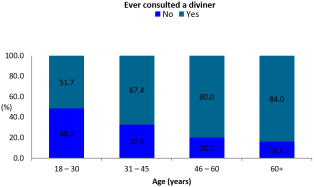
Figure 1 below shows how the various age categories ever practiced divination among Ghana's Northern Region's Dagomba.
Figure 1. Cross-tabulation of age and consulting a diviner.
There were significant differences between the age categories and the consultation of a diviner, with the level of consultation increasing with age. The 60 or more-year-old had the highest (84.0%) number of respondents who have ever consulted a diviner compared to 51.7% of the 18 -30 year old having ever done so. The level of ever consulting also increased as number of spouses, children and dependents increased.
This means that as the one advances in age, the propensity of practicing divination is very high. Also, as the number of dependents and spouses increases there is high tendency for one to practice divination. The implication is that, Oppong
| [32] | Oppong, C. (1973). Growing up in Dagbon. (First, Ed.). Accra, Tema.: Ghana publishing Corporation. |
[32]
explains that the Dagomba practice divination to seek for health and other opportunities such as wealth, political stability, pregnancy, birth issues among others, for their families, relatives and friends.
2.2. Number of Spouses and Children of Respondents’
Out of the total sample, 107 (27.5%) respondents had no spouse, 228 (58.6) respondents had at least 1 spouse, 46 (11.8) had 2 spouses, while 22 (5.7) respondents had at least 3 spouses. This means that the majority of respondents had at least one spouse. In terms of the gender dimension, 54 females had no spouse while 39 males have not married as well constituting 26.9% and 20.7% respectively of the female and male sample. Again, 147 females had one spouse and 81 males had one spouse as well, constituting 73.15% and 43.1% respectively of their respective samples. With regards to two and three or more spouses none of the females had two or three or more husbands. This means that all the respondents with two or more spouses were males. This indicates a polygamous society.
In terms of the number of children of the respondents, 107 (27.5%) had no child, 114 (29.3%) had at least 1-3 children, 97 (24.9%) had 4-7 children while 71 (18.3) had at least 7 children. This means that the majority of the respondents (72.5%) had at least a child.
In terms the gender breakdown, 63 of the female sample and 44 of the male sample constituting 31.3% and 23.4% respectively of female and male samples have no child. Among those who have 1 -3 children, 58 are females and 56 males made up of 28.9% and 29.8% of the female and male sample respectively, had one to three children. Among those with 4 -6 children, there are 48 females and 49 males constituting 23.9% and 26.1% of the female and male sample respectively. For those with 7 or more children, 32 are females and 39 males constituting 15.9% and 20.9% respectively of the female and male sample. Up to 71 people made up of 18.3% of respondents had 7 or more children. This indicates the high fertility rate of the population.
2.3. Number of Respondents Dependents
Regarding the quantity of dependents of the respondents, 93 (23.9%) had none, 81 (20.8%) had at least 1-3 dependents, 94 (24.2%) had 4-7 dependents while 120 (30.9%) had at least 7 dependents. This means that the majority of the respondents (76.1%) had at least a dependent to look after. The implication is that, given that majority of the respondents have dependents, they are likely to seek divine solutions for the problems they face in nurturing dependents. Among those who had one to three dependents, 47 are females and 34 males constituting 23.4% and 24.5% respectively of the female and male sample respectively. For those with 7 or more dependents 42 are females and 78 males constituting 20.9% and 41.5% respectively of the female and male sample.
In terms of educational attainment, 253 (65.0%) did not have any formal education, 18 (4.6%) had primary education, 19 (4.9%) had JHS/Middle school education, 31 (8.0) had SHS/A’ Level, and 68 (17.5%) had tertiary education (see
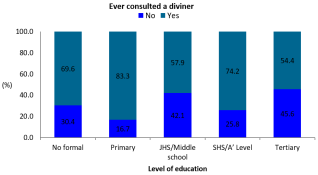
Figure 2) This means that the majority of the respondents (65%) cannot neither read nor write. In terms of the gender analysis, 145 females and 108 males constituting 72.1% and 57.5% respectively of the female and male sample had no formal education. The diagram below depicts how level of education influences the practice of education among the Dagomba.
Figure 2. Cross-tabulation of Level of education and consulting a diviner.
2.4. Level of Education and Diviner Consultation
From the
Figure 2 above, those respondents whose highest education was at the primary level had the highest level of diviner consultation history 83.3%, however, 16.7% of that same category had never consulted diviners. This was followed by those with senior secondary level education with 74.2%. Those with at least tertiary education had the lowest level which is 54.4%. Again, from
Figure 2, 69.6% of those in the sample were not formally educated. but ever consulted diviners while 30.4% never consulted diviners and had no formal education. The study found that the practice of divination is not necessarily dependent on the level of education. This is because more than have of the people in each educational category ever consulted a dinner. for one reason or the other as depicted in
Figure 2.
2.5. Religion and the Practice of Divination
With regards to the religion of the respondents, 85.9% of the sampled population practice Islam, 11.3% practice Christianity and 2.8% practice African Traditional Religion and the others (see
Table 1).
Evidence from science on the nature and causes of illnesses and the best ways to treat them typically informs health care practice. For instance, the philosophy of the majority of religions, including Islam and Christianity, demonstrates that religion is not only founded on moral and spiritual concerns about individuals, but also on their physical and mental health. For instance, the Bible states that Jesus gave His twelve followers instructions to proclaim "the Kingdom of God and to heal" (Luke, 9: 2). "...and We send down from the Quran that which is a healing and a mercy to those who believe," the Holy Quran further said (17: 82). The notion that spiritual factors contribute to illness is found in nearly every religion in the world. For instance, faith-based treatment is associated with demon possession and witchcraft. According to Cockerharm
| [15] | Cockerham, W. C. (2007). Medical Sociology (tenth). New Jersey: University of Alabama, Birmingham. |
[15]
, the clergy should be in charge of treating mentally ill individuals. The therapy included exorcism, touching relics, holy water, the priest's breath and spittle, prayers, and trips to holy locations. In the guise of therapy, all of these actions occur inside the religious realm.
In line with the occupation of the respondents 24,2% were engaged in farming, whiles 25.2% were traders and 8.7% were house wives and 18.0% belong to the other trades. The diagram below (
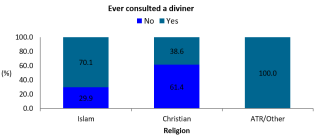
Figure 3) indicates the level of religious practice and consultation of diviners among the Dagomba.
2.6. Religion and Diviner Consultation
Figure 3. Cross-tabulation of religion and consulting a diviner.
In
Figure 3 above, there are differences across religion in consulting a diviner with all in the traditional/other religion group having ever done so, and 70.1% of the Muslims having ever done so compared to 38.6% of Christians doing so. This means that the practice of divination is most popular among adherents of African traditional and related religions and least popular among Christians. In a focus group discussion, one participant intimated that despite divination's opposition to the tenets of their faith, Muslims nonetheless held it to be true.
2.7. Income Level of Respondents
Table 2. Income level of respondents by gender.
| N (%) |
| Female | Male | Total |
Monthly income | | | |
None | 60 (29.9) | 45 (23.9) | 105 (27.0) |
<100 | 22 (11.0) | 12 (6.4) | 34 (8.7) |
100 -499 | 72 (35.8) | 60 (31.9) | 132 (33.9) |
500 -999 | 34 (16.9) | 32 (17.0) | 66 (17.0) |
1,000+ | 12 (6.0) | 39 (20.7) | 51 (13.1) |
Total | 201 (100.0) | 188 (100.0) | 389 (100.0) |
Source: Field Data, 2016.
With regards to the monthly income of the respondents, 27.0% did not earn any income, 87% earned less than GH¢100.00, 33.9% The earnings ranged from GH¢100.00 to GH¢499.00 for 9%, GH¢500.00 to GH¢999.00 for 17.0%, and 13.9%earned GH¢1,000.00 or more.
Considering the income level of the respondents, as indicated above that majority of them 27.0% do not earn any income, and 33.9% receive less than Ghc 100.00 to Ghc 499.00. The study found out that practice of divination is not being influenced by money. As is indicated in the quantitative study where people without income do go for diviner services.
2.8. Respondents’ Divination Experience
Table 3 below reveals respondent’s experiences with the practice of divination. The data in the table entail multiple responses. Regarding the respondents perspective on the function of divination in society, this study found out that, 8.0% of the sampled population intimated diviners provide such services regarding social, political and relationship services in the community. As many as 78.0% of respondents indicated that diviners provide health care and welfare services to the society while 29.5% indicated they provide marital, spiritual and supernatural and consultancy services. In addition, 26.9% said diviners provide economic and business development planning services, and 58.6% mentioned general family and social guidance, 23.8% intimated spiritual services and 11.1% indicated political stability.
With regards to respondents’ perspective on situations that would call for divine intervention, thee study found that 41.8% associated the circumstance to health reasons, 19.4% attributed it to spiritual problems and 17.3% associated it to business plans. Another 14.6% attributed it to interpretation of dreams, 3.2% said when taboos are broken and 4.3% indicated clairvoyance and 10.5% attributed it to other reasons.
Table 3. Divination experience and practice by gender.
| N (%) |
| Female | Male | Total |
Respondent’s view of role of diviner in the community |
Giving advice | 16 (8.0) | 15 (8.1) | 31 (8.0) |
Providing health services | 156 (77.6) | 145 (78.4) | 301 (78.0) |
Marital advice/consultations | 56 (27.9) | 58 (31.4) | 114 (29.5) |
Economic/business advice | 55 (27.4) | 49 (26.5) | 104 (26.9) |
Soothsaying/clairvoyance | 32 (15.9) | 28 (15.1) | 60 (15.5) |
General family/social guidance | 106 (52.7) | 120 (64.9) | 226 (58.6) |
Spiritual help | 59 (29.4) | 33 (17.8) | 92 (23.8) |
Political help | 22 (11.0) | 21 (11.4) | 43 (11.1) |
Circumstances that would necessitate need of a diviner |
Health | 79 (41.8) | 76 (41.8) | 155 (41.8) |
Spiritual | 37 (19.6) | 35 (19.2) | 72 (19.4) |
Business/farming/lost property | 37 (19.6) | 27 (14.8) | 64 (17.3) |
Help with dreams | 26 (13.8) | 28 (15.4) | 54 (14.6) |
Consult ancestors/broken taboos | 5 (2.7) | 7 (3.9) | 12 (3.2) |
Soothsaying/clairvoyance | 6 (3.2) | 10 (5.5) | 16 (4.3) |
Critical problems | 20 (10.6) | 19 (10.4) | 39 (10.5) |
Other | 13 (6.9) | 11 (6.0) | 24 (6.5) |
Member of family who determines when to consult a diviner |
Family head | 148 (73.6) | 169 (89.9) | 317 (81.5) |
Any member of family | 15 (7.5) | 8 (4.3) | 23 (5.9) |
Father | 20 (10.0) | 9 (4.8) | 29 (7.5) |
Mother | 3 (1.5) | 0 (0) | 3 (0.8) |
No one | 15 (7.5) | 2 (1.1) | 17 (4.4) |
Types of problems addressed by diviners within the community |
Spiritual | 77 (51.7) | 74 (49.7) | 151 (50.7) |
Health/mental | 87 (58.4) | 99 (66.4) | 186 (62.4) |
Business/economic | 28 (18.8) | 30 (20.1) | 58 (19.5) |
Political | 22 (14.8) | 18 (12.1) | 40 (13.4) |
Marital | 9 (6.0) | 12 (8.1) | 21 (7.1) |
Social | 19 (12.8) | 10 (6.7) | 29 (9.7) |
Soothsaying | 7 (4.7) | 4 (2.7) | 11 (3.7) |
Other | 11 (7.4) | 11 (7.4) | 22 (7.4) |
Total | 201 (100.0) | 188 (100.0) | 389 (100.0) |
Sourece: field data 2016.
As to who consults a diver in the family, majority of the respondents (81.5%) intimated family head, 5.9% indicated any family member, 7.5% said the father of the sick person and 0.8% said the mother while 4.4% said no one. As to the type of problems addressed by diviners in the community, 50.7% of the sampled population attributed it to the spiritual problems, 62.4% said health problems, 19.5% intimated business or economics development, 13.4% indicated political stability, 7.1% attributed it to marital, pregnancy and birth outcomes, 9.7% said social, 3.7% indicated clairvoyance and 7.4% attributed it to other reasons.
Table 4. Evidence of divination outcome by gender.
| N (%) |
| Female | Male | Total |
Respondent has evidence of the divination outcome | | | |
No | 56 (27.9) | 45 (23.9) | 101 (26.0) |
Yes | 145 (72.1) | 143 (76.1) | 288 (74.0) |
Benefits of divination | | | |
Health | 57 (33.3) | 48 (29.8) | 105 (31.6) |
Spiritual help/protection | 35 (20.5) | 34 (21.1) | 69 (20.8) |
Hope/encouragement | 35 (20.5) | 37 (23.0) | 72 (21.7) |
Destroying others | 4 (2.3) | 7 (4.4) | 11 (3.3) |
Business/economic success | 29 (17.0) | 28 (17.4) | 57 (17.2) |
Political gains | 15 (8.8) | 13 (8.1) | 28 (8.4) |
Social benefits | 19 (11.1) | 23 (14.3) | 42 (12.7) |
Academic success | 7 (4.1) | 3 (1.9) | 10 (3.0) |
Soothsaying | 11 (6.4) | 8 (5.0) | 19 (5.7) |
Other | 25 (14.6) | 15 (9.3) | 40 (12.1) |
Consequences possible for not heeding to diviner’s advice | | | |
No | 46 (22.9) | 36 (19.2) | 82 (21.1) |
Yes | 155 (77.1) | 152 (80.9) | 307 (78.9) |
Total | 201 (100.0) | 188 (100.0) | 389 (100.0) |
With regards to the evidence of divination outcome, the study found that, 74.0% of the sampled population intimated that they have the experience and practice of divination and its outcome. 26.0% of the sampled population did not have the experience and the outcome of divination.
Explaining the benefits of divination in treatment of illnesses, the respondents have the following to say. About 31.6 respondents intimated that divination is used to solve their health related problems. Only 69 people constituting 20.8% of the sampled population associated the benefits of divination to solving spiritual problems.
Another 21.7% associated the benefits of divination to hope and encouragement, 3.3% attributed the benefit of divination to destroying others, 57 people constituting 17.2% of the sampled population associated the benefits to political stability. Only 12.7% likened it to social benefits while 3.0% attributed the benefits to academic success.
2.9. Women and the Practice of Divination
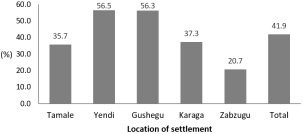
Considering the quantitative nature of this study across the five MMDAS sampled for this study, 35.7% of the residence sampled in Tamale Metropolis intimated that women can seek for diviner services in terms of their health practices while 64.3% intimated they cannot go to the diviner due to cultural reasons. Again, 56.5% of the sample population in Yendi Municipality asserted that women can practice divination as against 43.5 who intimated that women cannot seek diviner services. In Gushegu District, 56.3% of the study population indicated women can equally practice while 43.7% said women cannot practice divination. In the same vain, 37.3% of the sampled population in Karaga District said women can practice divination as against 62.7% who indicated that women cannot go for the divination services for health reasons. In Zabzugu District, 20.7% of the sampled population asserted that women can practice divination while 90.3% asserted that women cannot practice divination for their health or otherwise.
Figure 4. Women participation in divination.
From
Figure 4 above, Yendi and Gushegu had the highest percentages of women residents indulge in divinity with the lowest being Zabzugu. This findings supports Connell
| [13] | Connell, R. (2009). Gender: in world perspective. American Sociological Review, 8(4), 1-12. |
[13]
writings in feminism. According to the author, African feminism considers the various forms of oppression that African women experience.
When the issue of women participation in divination was brought up at the start of the pretest of the instruments, it was indicated that women should be excluded from the sample. But several factors came in to mind to include them to ascertain gender practice in patriarchal community such as this. It is therefore not surprising when 64% of the population in Tamale said women cannot practice divination. In Karaga District, 62.7% equally ascertained that women cannot practice divination. This finding is consistent with Ngom etal.,
| [29] | Ngom, P., Debpuur, C., Akweongo, P., Adongo, P., &, F. N. (2003). Gate keeping and women’s health seeking behaviour in Navrongo, Northern Ghana. African, Journal of Reproductive Health. 7(1), 17-26. |
[29]
explanation that in most patriarchal societies women and children voices are not heard. In most polygamous societies the desire to produce more children is regarded as wealth especially the boy child. As such, people divinate in other to find answers to problems that confront their daily life. One of the diviners questioned, "If a woman goes to divine, what wisdom will a man use to rule her again?" in response to questions about women performing divination, the diviner said I will not divine a woman if she comes alone for divination services. However, when she comes with her husband or brother or son, I will divine them but for her to come alone to divine I will not do it”. The above statement from the diviner is consistent with Connell
| [14] | Connell R. (1987). Theroy of gender and power. Stanford University Press, Palo Alto. |
[14]
assertion that women every where in the planet face multiple oppression. This means that gender differences exist in every society.
3. Discussions
3.1. Socio-demographic Characteristics
The ages for diviner consultation ranged between the ages of 18 and 60 or older. The age range was chosen with the thinking that Children don't seek the advice of diviners.. This thinking was supported with the statistics of various age ranges that consult for diviner services as the age increases. As such, the likelihood of older people consulting diviners is higher. than the younger age group. For example 84% of the sampled population in
Figure 1, falls within the 60+ years category who ever consulted diviners for health and other reasons. Beside, the cultural customs of the individuals in the research communities, holds the view that in matters of decision making it is the house hold head who dose so by consulting diviners. This is consistent with Azong etal,.
| [8] | Azongo, T. B., & Wombeogo, M. (2015). Consulting Diviners for Health: The Influence of Socio-Demographic Factors On the Use Of Divination In Health-Seeking In Northern Ghana. International Journal of Innovative Research and Studies, 4(1), 176-193. |
[8]
findings that 83.1% of Nabdams in the Upper East region of Ghana aged 60+ consult diviners on behalf of their families.
Regarding number of spouse and practice of divination, the study revealed that 147 females had one spouse and 81 males had one spouse constituting 73.15% and 43.1% respectively. Since the study area is dominated with patriarchal system males are bound to be decision makers in the community on behalf of women and children. This finding is consistent with Assimeng
| [5] | Assimeng, M. (2010). Religion and Social Change in West Africa (Second). Accra: Woeli Publishing Services. |
[5]
assertion that children are seen as wealth in Ghanaian societies. In term of number of children, 72.5% of the sampled population had at least one child and 24.9% had 4 to 7 children. Up to 18.3% had 7 or more children. The implication is that, the fertility rate is high in this community. This again supported According to Assimeng
| [5] | Assimeng, M. (2010). Religion and Social Change in West Africa (Second). Accra: Woeli Publishing Services. |
[5]
, the majority of Ghanaian civilizations view children as a source of income. The implication is that the more dependant a parent has the more likelihood of diviner consultation for health seeking.
3.2. Level of Education of the Respondents
Regarding educational attainment and diviner consultation, those with no formal education and those with lower level of education are more likely to patronize diviner services as indicated in
Figure 2, 69.6% of those with no formal education and 83.3% of those with primary level had ever consulted diviners as against 54.4% at the tertiary level. This finding supports the findings of Mendonsa
| [26] | Mendonsa, E, L. (1982). The Politics of Divination. A Processual View of Reaction to Illness and deviance among the Sisala of Northern Ghana (First). California: University of California Press. |
[26]
on politics of divination among the sisala where illiterates and those with no low level of education are engaged divination to find answers to political and health problems in their society. Therefore, those whose highest level of education was at the primary level, had highest chances of diviner consultation which is 83.3% as against those with at least tertiary education had the lowest level of diviner consultation, which is 54.4%. This finding agrees with Azongo and Wumbego
| [8] | Azongo, T. B., & Wombeogo, M. (2015). Consulting Diviners for Health: The Influence of Socio-Demographic Factors On the Use Of Divination In Health-Seeking In Northern Ghana. International Journal of Innovative Research and Studies, 4(1), 176-193. |
[8]
assertion that 60% of Nandam educated people are less likely to patronize divination.
In terms of religion and divination, all the respondents in ATR. (Traditional African religion) traditional African religion indicated that they consult diviners for health and other reasons as shown in
Figure 3 above, 70.1% of Muslims had consulted diviners and 38.6% of Christians ever consulted diviners. The implication is that majority of the religions do not forbid the practice of divination. This supports the findings of Mbiti
| [25] | Mbiti, J. S. (1990). African Religions & Philosophy. London: Heinemann. |
[25]
that religion permeates in every facet of Ghanaian society.
3.3. Experience of the Respondents
Regarding respondents experience with divination, 70% asserted that diviner services provide health care, 26.9% said diviners provide economic and other business related services, 23.8% related their services to spiritual whiles 29.5% associated their services to marriage, chief-ship, and supernatural activities. In terms of evidence of divination outcome, 74% of the sampled population gave satisfied testimony to expediences and outcome of divination of the practice of divination being positive. This finding is consistent with the findings of Ngutor etal.,
| [28] | Ngutor, S. Lumun, A. & Terwase, I. (2013). The Role of Divination in Treatment of Disease in Kwande Local Government Area of Benue State, Nigeria. International Journal of Humanities and Social Science Invention, 2(10), 21-29. |
[28]
assertion that 78% of the sampled population in Benue State in Nigeria gave satisfaction of the diviner treatment.
3.4. Conclusion/Recmmedation
The study revealed that many people resort to divination as a method of improving their health. This tendency increases with age, number of children and wives. As ones education increase to the higher level, it reduces the chances of diviner consultation. Indeed, the population with polygamous marriages without formal education have a tendency to use divination for health purposes. Knowing and believing in supernatural causes of illnesses is a widespread phenomenon and this cannot be elucidated by modern science. As long as people believe that illnesses might be caused by supernatural forces, they will at all cost resort to supernatural prognosis.
The implication for treatment is more significant in conventional patient care. Thus, it is advised that health professionals should be mindful of the fact that majority of the population do resort to diviner treatment even when they are receiving orthodox treatment at the hospital.
Again, it is recommended that GHS (Ghana health service) and MOH (Ministry of health) should fashion out policies to include diviners in the health delivery since people patronize their services whether we like it or not.
As a matter of agency the government should equip the diviner through health promotion and education inform clients to report first to a health facility before reporting to a diviner.
Indeed, this study used quantitative approach further studies could use mix method approach to in-adeptness of individual feelings.






 Share This Article
 Twitter
 Linked In
 Facebook
 Copy
Copy Download